

My old gas trimmer and I had a relationship that could only be described as deeply dysfunctional. It needed fresh fuel every spring, a new spark plug every other year, and about fifteen yanks on the starter cord before it would even consider running. Last May it just gave up entirely, right in the middle of a Saturday I had set aside for the whole yard. I stood there, sweating, cord in hand, and thought: I am done with this. I ordered the WORX 20V Cordless String Trimmer and Edger that afternoon. Two full lawn seasons later, here is everything I know about it.
The WORX 20V has a 4.4-star rating across nearly 28,000 Amazon reviews, which is not a small number. That told me people were buying it and mostly happy, but it did not tell me how it holds up across a hundred-plus hours of real yard use, or what happens to the Command Feed spool on year two, or whether the edger pivot is still tight after two seasons of flipping it back and forth. That is what I wanted to find out, and that is what this review covers.
The Quick Verdict
A genuinely capable cordless trimmer that makes edging easy and starts every single time. Battery life is the real ceiling for bigger lawns, but for a typical suburban yard it is more than enough.
Amazon Check Today's Price →If your gas trimmer is fighting you, this is the upgrade that actually works on the first try.
The WORX 20V cordless trimmer converts from trimmer to edger without a separate tool. Check the current price on Amazon before it changes.
Amazon Check Today's Price on Amazon →How I've Used It
My yard is not a showpiece. It is a third of an acre in central Ohio, clay soil, and the kind of lawn that grows aggressively along the driveway and sidewalk edges and then decides to ignore the back corner near the fence. I have a 60-foot concrete driveway border, about 80 feet of sidewalk edge, a wraparound flower bed along the front of the house, and a back section around a raised bed garden that always catches more grass than it should.
I trim once a week through the active growing season, which here in Ohio runs from mid-April through October. That is roughly 28 sessions per season, 56 total since I bought the WORX. Each session I use it for both trimming and edging: trimming first along the fence line and flower beds, then I pivot the head 90 degrees and walk the driveway and sidewalk edges. An average session runs about 25 to 30 minutes of actual run time.
I am not a professional lawn care person. I am a gardener who also has a lawn and prefers to deal with it efficiently and get back to the beds. I have bad knees from a decade of competitive soccer in my twenties, so heavy tools are a genuine problem for me, not just a preference. The WORX is light enough that I can use it for a full session without my wrists and shoulders complaining, which matters more than I expected it to.
Battery Life: The Number That Actually Matters
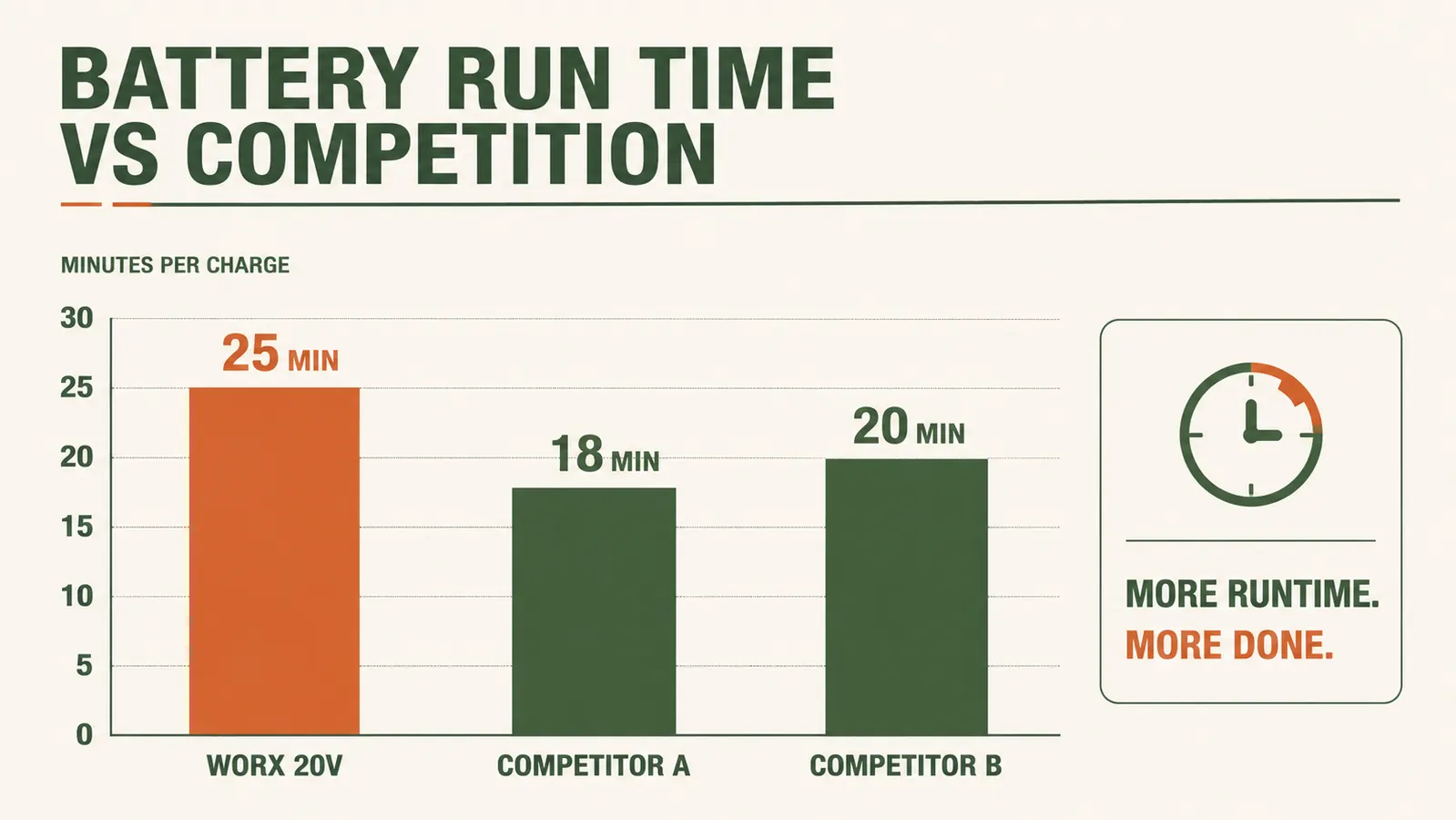
This is where most cordless tool reviews wave their hands and say something like 'great for most lawns' without telling you what 'most lawns' means. So here is what I actually tracked. My typical session of trimming plus edging the driveway, sidewalk, and front bed takes between 24 and 30 minutes. The WORX 20V battery, when fully charged, has given me consistent runtime in that window. I have never run out of battery mid-session on my third-of-an-acre yard.
What I have noticed is that battery performance in year two is marginally shorter than year one. Not dramatically. I would estimate I lose maybe two or three minutes of runtime compared to when the battery was new. That is not unusual for lithium-ion batteries after 56-plus charge cycles, and it has not yet caused a problem. If I had a half-acre or more, I would want a second battery without question. For my lot, one charge handles everything.
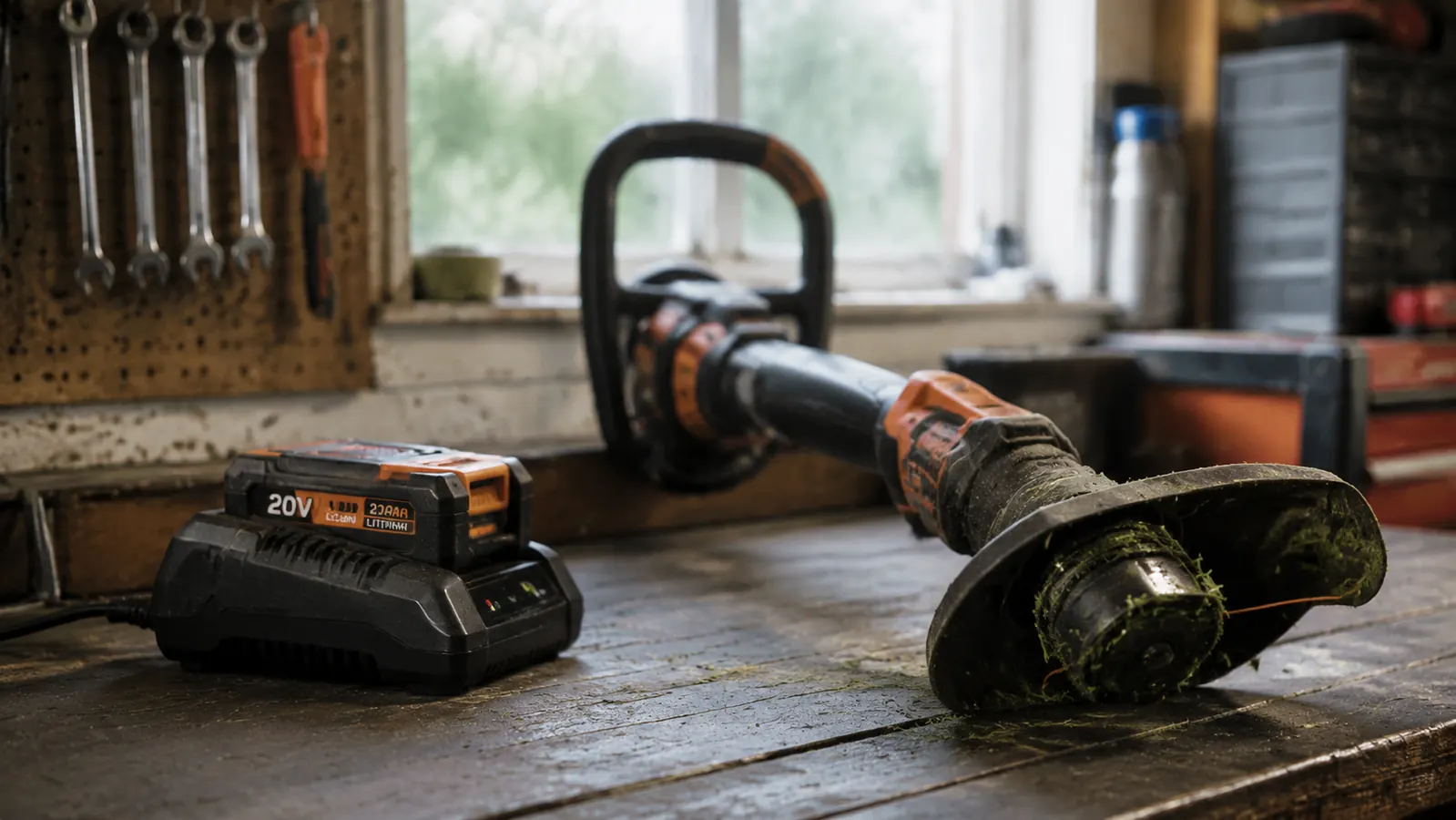
Charging takes about an hour for a full charge. I plug it in the night before a mowing day so it is always topped off. The charger is simple and reliable. No complaints there.
The Edger Function: The Real Selling Point
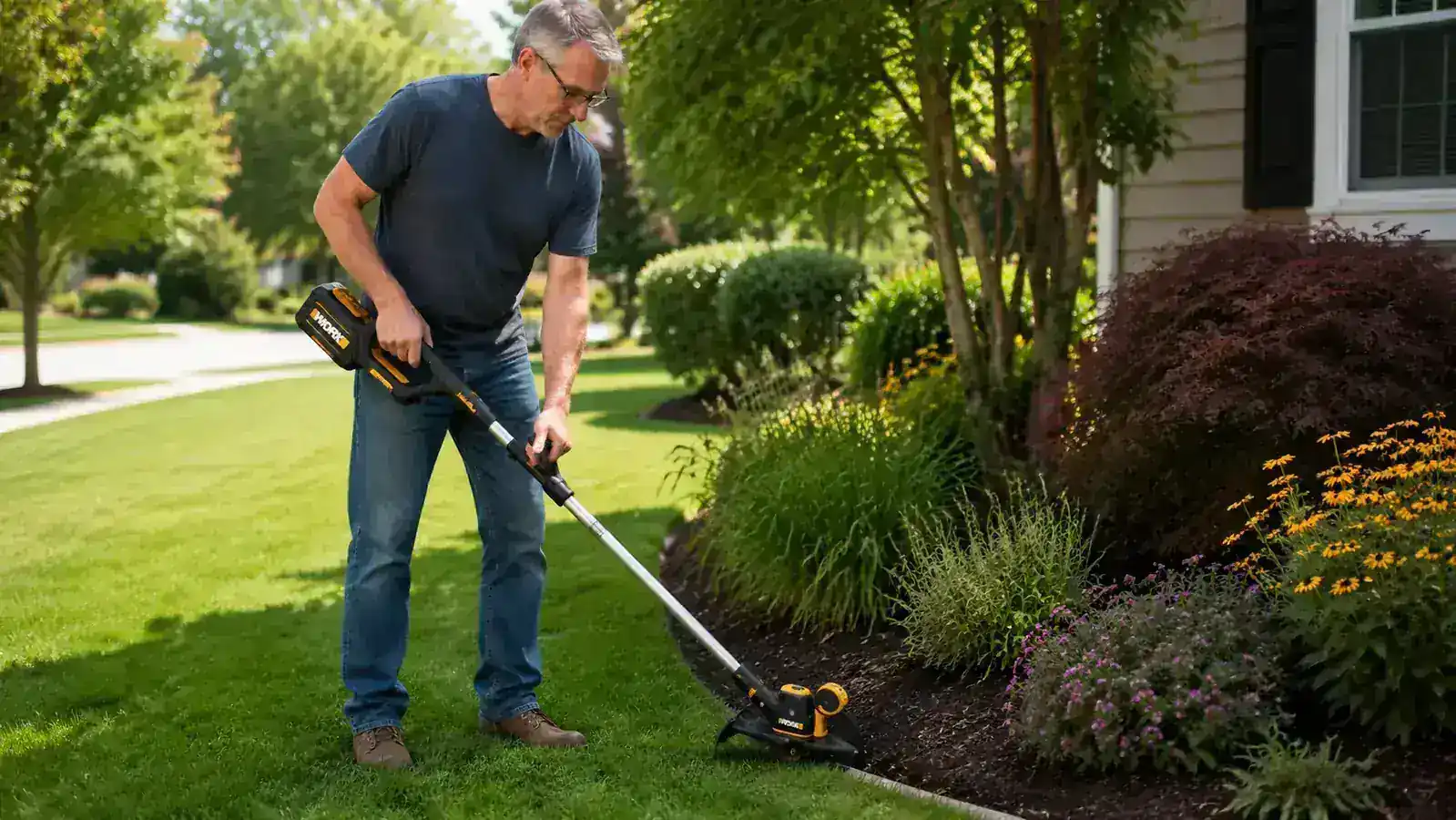
Here is the thing about this trimmer that the product listing undersells. Yes, it is a string trimmer, and it works fine as a string trimmer. But the edger mode is what I reach for every single week, and it is genuinely good. You tilt the head 90 degrees, lock it into edger position, and run it along the driveway or sidewalk with the guard riding the edge. The line cuts a clean vertical line through any grass that has crept over the concrete.
I want to be specific about what 'clean' means here because I was skeptical. Before the WORX, I used a dedicated Black and Decker edger for my driveway and a trimmer for the beds. Two separate tools. The WORX does the edger job well enough that I sold the dedicated edger. The line is sharp, the depth is consistent if you walk at an even pace, and the guide wheel keeps the head from digging in. After two seasons I would give the edging performance a solid 8 out of 10. It is not a professional landscape-grade edger, but for a homeowner doing weekly maintenance it is excellent.

Command Feed: The Spool System That Saved My Patience
I have spent more time in my gardening life fighting string trimmer spools than I would like to admit. If you have ever wrestled with a bump-feed spool, jammed the line, or spent ten minutes trying to thread replacement string, you know exactly what I mean. The WORX Command Feed is different: you press a button on the handle when you need more line, and more line comes out. That is it. No bumping the head on the ground, no stopping and crouching to manually advance the line.
After two seasons, the Command Feed system still works exactly as described. I have replaced the spool twice. The WORX replacement spools are specific to this trimmer (0.065-inch line), and they are readily available on Amazon. Installing a new spool takes about three minutes: pop out the old one, click in the new one. I did try the Worx-compatible third-party spools that are cheaper, and they worked fine for about half a season before the line started hanging up. I went back to the WORX brand spools. Worth the extra dollar or two to not have it jam during the middle of a session.
I have replaced the spool twice in two seasons. Three minutes each time. That is the whole maintenance story on the line feed, and I genuinely cannot complain about it.
Weight and Ergonomics After Sore-Knee, Sore-Wrist Reality
The WORX 20V weighs about 5.3 pounds with the battery installed. That sounds light on paper, and compared to my old gas trimmer it absolutely is. But how it actually feels depends on how you hold it. The handle design puts the battery behind your grip arm, which keeps the tool balanced rather than nose-heavy. For a 25-minute session I do not feel significant fatigue in my wrists or shoulders, which was not true with my old gas trimmer after 15 minutes.
The auxiliary front handle is adjustable and makes a real difference for edging. When I flip into edger mode I shift my grip and the front handle gives me a stable two-handed position that keeps the cut line consistent. I did not expect that detail to matter as much as it does. For anyone with wrist or shoulder issues, the ergonomics are notably better than a straight-shaft gas trimmer.
What Two Seasons of Use Taught Me About the Limits
Let me be honest about the things that are genuinely not as good. The 12-inch cutting swath is on the narrow side. Most gas trimmers cut 15 to 17 inches. If you have a large yard with significant open-area trimming (not just edges, but big patches of overgrown grass), that narrower swath will slow you down. For my yard it has not been a problem because I mostly edge and trim tight spaces, but if your primary use is trimming half-acre fence lines, I would want something with more cutting width.
The second real limit is thick, woody vegetation. The 20V motor handles standard lawn grass easily in both trimmer and edger modes. It slows noticeably on thick stands of ornamental grass or anything with woody stems. I have a patch of ornamental grasses near the back fence that I let go too long one season, and the WORX struggled with the base of those stalks. For normal lawn-edge work you will never hit this limit, but I wanted to mention it.
One more thing: the plastic guard can rattle loose over time. Mine started rattling in year two. The fix was a ten-second tighten with a screwdriver. Not a serious issue, but if you hear a rattle, check the guard before assuming something is wrong with the motor.
What I Liked
- Starts instantly every single time. No cord, no fuel, no ritual.
- Edger pivot is solid and still tight after two full seasons of weekly use.
- Command Feed line advance is genuinely convenient and rarely jams with brand-name spools.
- Light enough for a full session without shoulder or wrist fatigue.
- Replacing the spool takes three minutes and the spools are easy to find.
- Quiet enough to use early in the morning without angering the neighbors.
Where It Falls Short
- 12-inch cutting swath is narrower than most gas trimmers. Bigger yards will feel it.
- One battery is enough for a typical suburban lot but you will want a second for anything larger.
- Struggles with very thick ornamental grass or woody stems at the base.
- Third-party replacement spools are inconsistent. Stick to WORX brand to avoid line jams.
- Battery capacity shows modest decline by year two after heavy charge cycling.
How It Compares to What Else I Considered
Before I ordered the WORX I seriously looked at the Black and Decker 20V trimmer, which is a comparable price and has similar reviews. I have used both now, because a neighbor bought the Black and Decker around the same time and we compared notes. The Black and Decker is also a solid trimmer. The WORX edges ahead for me on two things: the edger pivot is more reliable (my neighbor's Black and Decker head has loosened over time and requires re-tightening before every edging session), and the Command Feed is more intuitive than the bump-feed on the Black and Decker. If you are choosing between the two, I lean WORX for the edger conversion and the spool system. If you already have Black and Decker 20V batteries in the garage, the math might flip in their favor since you can skip buying a new battery. You can read the full side-by-side in my WORX vs Black+Decker cordless trimmer comparison.
If you are coming from a gas trimmer, the biggest adjustment is thinking about battery charge the same way you think about fuel. Charge it the night before, and you will never notice the difference in a typical session. If you forget, 20 minutes on the charger gets you about half a charge, which might be enough for a quick edge but not a full session. The habit shift is real but minor.
Who This Is For
The WORX 20V cordless trimmer is a great fit if you have a standard suburban yard, between a quarter and a third of an acre, where most of your trimmer work is edging driveways, sidewalks, and flower bed borders. It is also a good fit if you are done wrestling with a gas trimmer and want something that starts reliably, stores simply, and handles routine maintenance without making you feel like a small-engine mechanic. It suits gardeners with wrist or shoulder sensitivity who need a lighter tool. If you want to understand how it stacks up against the cordless-vs-gas question more broadly, see my overview of why a cordless trimmer beats a gas weed eater for most homeowners.
Who Should Skip It
If you have a half-acre or more of open trimming area, this will not be fast enough or have enough cutting width. A 20V brushless trimmer with a 15-inch cutting path would serve you better, or you will need a second battery and patience. If you need to regularly cut through thick ornamental grass clumps, dried woody brush, or anything with real resistance at the stem, a more powerful cordless or a gas trimmer is a better tool. And if you already have an 18V or 40V battery platform from another brand, check whether they make a compatible trimmer before buying a whole new battery ecosystem.
Two seasons in, I would still buy this trimmer over the gas model it replaced.
The WORX 20V cordless trimmer starts instantly, edges cleanly, and has held up through two full lawn seasons without any real complaints. Worth checking the current price on Amazon.
Amazon Check Today's Price on Amazon →